Double-bookings, poorly planned routes, and last-minute cancellations are not just inconveniences. They are a quiet drain on your most valuable resource: your technicians’ time in the field. And for most HVAC businesses, the damage is happening before lunch.
Your technicians started at 7:30 this morning. By 9:00, one of them is sitting in his truck in a driveway, waiting for a customer who forgot the appointment was today. Another is driving thirty minutes across town to a job that could have been handled by a tech who was already in that area. A third just got a call rerouting him to an emergency, leaving a scheduled maintenance window unfilled.
It is not even noon, and you have already lost hours that you cannot get back.
This is not a staffing problem. You have capable technicians. This is a scheduling problem and for most HVAC companies, it happens so consistently that it starts to feel like the normal cost of doing business. It is not. It is a fixable inefficiency that AI dispatch for HVAC companies is already solving for the businesses that have made the switch.
Three Scheduling Problems HVAC Companies Accept Without Realizing They Shouldn’t

1. Double-Booking and Calendar Conflicts
It usually starts with a well-meaning person on the phone trying to accommodate a customer. A slot gets booked manually. A second call comes in and someone books the same tech at the same time, or books a job that physically cannot follow the one before it given drive time. By the time the day starts, the schedule has holes, overlaps, and gaps that force your dispatcher to scramble.
Manual scheduling systems even good ones are not built to catch these conflicts in real time. The error often isn’t discovered until the tech is already on his way. At that point, the damage is done. Someone is getting a delayed arrival, and your dispatcher is already on the phone apologizing.
2. Route Planning That Ignores Geography
Sending the nearest available technician sounds logical until you realize the schedule was built without any awareness of where jobs are clustered, where your techs are starting from, or how traffic patterns shift through the day.
A tech covering five jobs in a single day might drive over sixty miles doing it, where a smarter route would have covered the same work in under thirty. That extra drive time is not billable. It does not show up as a line item in your accounting but it is real time your technician is not doing revenue-generating work. Over a full season, those miles and hours add up to a number that should make any owner uncomfortable.
3. Last-Minute Rescheduling Without Ripple Management
A customer cancels at 8:00 AM. Someone takes the call, marks the job as cancelled, and moves on. But no one reassigns the tech who just freed up. No one contacts the customer who has been on the waitlist for three days. The slot disappears.
In a well-run operation, a cancellation is an opportunity to compress the schedule, move up a waiting customer, and keep every technician productive. In most HVAC businesses, it is just a gap. A quiet, invisible gap that no one ever quantifies because it never shows up anywhere as a cost. It just shows up at the end of the season when the numbers are softer than they should have been.
What the Numbers Actually Say
Field service research from Aberdeen Group found that inefficient scheduling and avoidable drive time account for roughly 23% of a field technician’s working day, time that generates no revenue and no customer value. ServiceTitan’s industry data puts the rate of same-day cancellations and no-shows for HVAC service appointments at approximately 1 in 4. When you stack those two figures together, you start to see the actual scale of the problem.
- 23% of a field technician’s day lost to avoidable drive time and scheduling gaps (Aberdeen Group)
- 1 in 4 HVAC service appointments affected by same-day rescheduling or no-shows (ServiceTitan Field Service Report)
- 4+ hours of productive field time lost per technician per week to poor dispatch, the equivalent of two full billable jobs
Multiply that across your team and across a full season. The number becomes significant very quickly.
What AI Dispatch for HVAC Companies Actually Changes
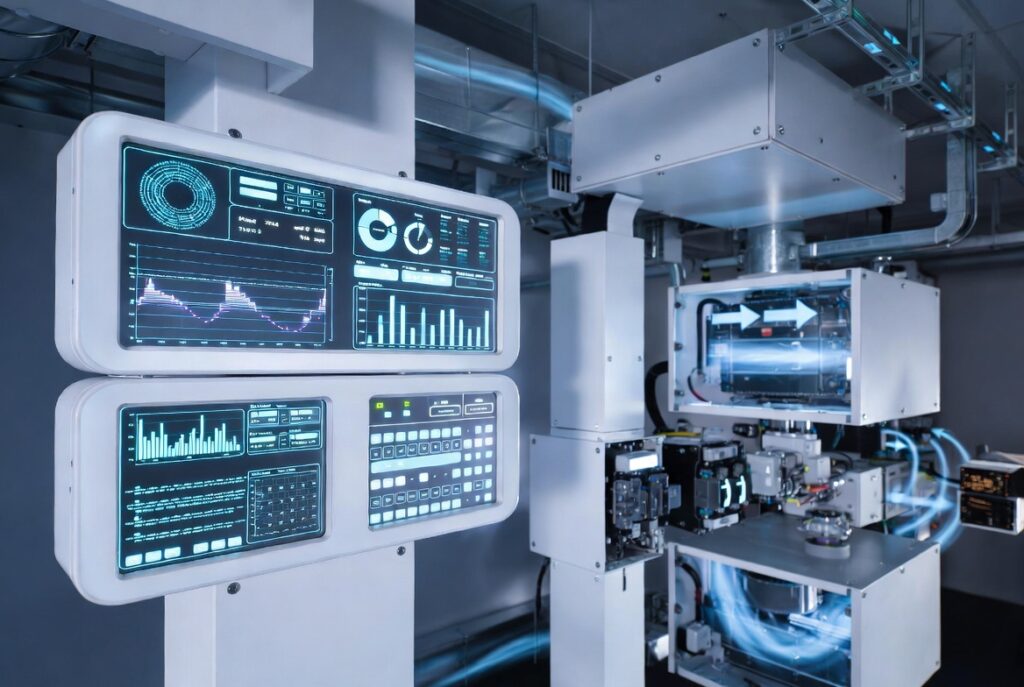
AI dispatch does not replace your dispatcher. It gives your dispatcher a system that handles the parts of the job that are mechanical, repetitive, and error-prone so your team can focus on the decisions that actually require judgment.
Here is what changes when AI is managing your dispatch logic:
- Bookings are checked against existing schedules, drive time, and tech proximity before they are confirmed. Conflicts are flagged or prevented not discovered after the fact.
- Routes are built around geography, not just availability. Jobs are clustered by area and sequenced to minimize total drive time across the day.
- When a cancellation comes in, the system automatically identifies the next best use of that time slot and either fills it from a waitlist or reassigns the technician to a closer job.
- Customers receive automated appointment reminders, reducing the no-show rate without anyone on your team having to make manual reminder calls.
- Your dispatcher sees a live view of where every tech is, what is next on their route, and where the schedule has room to absorb emergency calls without breaking the rest of the day.
Before and After: The Same 14 Jobs, Two Very Different Days
Before: Three techs cover 14 jobs. Combined drive time is 4.5 hours. Two gaps in the schedule go unfilled after a morning cancellation. One tech is double-booked at 2:00 PM and the dispatcher only catches it at 1:30.
After: The same 14 jobs are sequenced by zone. Drive time drops to 2.1 hours. The morning cancellation is filled within eight minutes from a waitlist customer. No double-booking reaches the field because the system flagged it at booking.
Same team. Same day. Meaningfully different output.
The Emergency Call Problem — Where Manual Scheduling Breaks Down Fastest
A customer’s AC fails on a 95-degree afternoon. They call in a panic. You need to get someone there fast without destroying the rest of the day’s schedule.
In a manual system, this usually means your dispatcher making a series of phone calls, eyeballing the board, and making a judgment call that may or may not be right. The tech who gets reassigned might be thirty minutes away when another was five. The jobs that get bumped might have been avoidable with a different sequence. The whole day absorbs the disruption and nobody really knows how much it cost.
AI dispatch for HVAC handles this in seconds. It identifies the closest available technician, calculates the downstream impact of the reassignment on every other job in the schedule, and surfaces a resolution that minimizes disruption across the whole day. Your dispatcher reviews it and approves. The tech is notified. The customer gets an update. The schedule repairs itself.
Every hour your technician spends in traffic or waiting on a no-show is an hour that could have been a billable job. That is not a small number over a full season.
What Poor Scheduling Is Actually Costing You in Revenue
The math is straightforward. If each of your technicians loses an average of four hours per week to avoidable scheduling inefficiency, and your average job takes two hours, that is two jobs per tech per week that are not getting done.
For a team of five technicians, that is ten jobs a week sitting uncaptured. At an average ticket value of four hundred dollars, you are leaving four thousand dollars on the table every single week, not because you lack the customers, not because you lack the staff, but because the schedule is not organized well enough to capture the capacity you already have.
Over a 20-week peak season, that is $80,000 in potential revenue your existing team was capable of generating. AI dispatch for HVAC does not grow your team. It recovers the output your team is already capable of delivering.
Your Dispatcher Becomes More Effective Not Redundant
A common concern when HVAC owners hear “AI dispatch” is that it removes the human element from a job that genuinely benefits from knowing your techs, your customers, and your service area personally.
That knowledge does not go away. It gets applied better.
When the mechanical work of conflict-checking, route optimization, waitlist management, and reminder calls is handled automatically, your dispatcher has more time and mental bandwidth for the decisions that actually need experience. Which customer needs extra care because they’ve had a bad experience before. Which tech is better suited for a complicated commercial job. When to push and when to give someone grace.
The AI takes the logistics. Your dispatcher keeps the relationships. That is not a trade-off that is an upgrade.
The Season Is Too Short to Leave Hours on the Table
Peak season for HVAC is a window. The demand is there. The phones are ringing. Whether your business captures that demand or lets it slip through an inefficient schedule is one of the most controllable variables in your entire operation.
The businesses that finish a busy season ahead of where they expected are not always the ones with the most technicians. They are often the ones that got the most out of the technicians they already had. And that starts with how the day is built before anyone leaves the shop.
AI dispatch is not a future investment. It is a present-season decision. The hours you recover this week are jobs you can bill this week.
Frequently Asked Questions
How does AI dispatch work for HVAC businesses?
AI dispatch connects to your existing booking system and automatically checks each new job against your techs’ availability, current location, and the geography of existing jobs. It sequences routes to minimize drive time, flags conflicts before they reach the field, and fills cancellations from your waitlist all in real time.
Will AI dispatch replace my dispatcher?
No. AI dispatch handles the mechanical, repetitive parts of the job conflict detection, route optimization, reminder calls so your dispatcher can focus on judgment calls that require experience and relationship knowledge. Most dispatchers find they are significantly more effective with AI handling the logistics layer.
How quickly can an HVAC business get set up?
Most businesses are fully operational within a single day. There is no lengthy implementation or staff retraining required. The system is built to fit around how your business already works, not the other way around.
What happens to emergency calls with AI dispatch?
Emergency calls are where AI dispatch delivers some of its clearest value. The system identifies the closest available tech, calculates the impact on the rest of the schedule, and surfaces the best resolution in seconds. Your dispatcher approves and the adjustment is made without the usual scramble.
Recover the Hours Your Schedule Is Losing
Every week that passes without an optimized dispatch system is another week of technician hours that cannot be recovered. The customers are there. Your team is capable. The only thing standing between your current output and what your business could actually be producing is the quality of the schedule they are working from.
Bot4orge’s AI dispatch is built specifically for HVAC operations the route logic, the cancellation handling, the emergency rerouting, all of it. Companies using it are recovering an average of 6–8 billable hours per technician per week within the first month.
Book a free 20-minute demo and we’ll show you exactly what your current schedule is costing you — with no commitment and no sales pressure. Just the numbers, and what they mean for your season.