Here’s How AI Captures Every Single One.
The Problem Nobody Talks About at the HVAC Trade Show
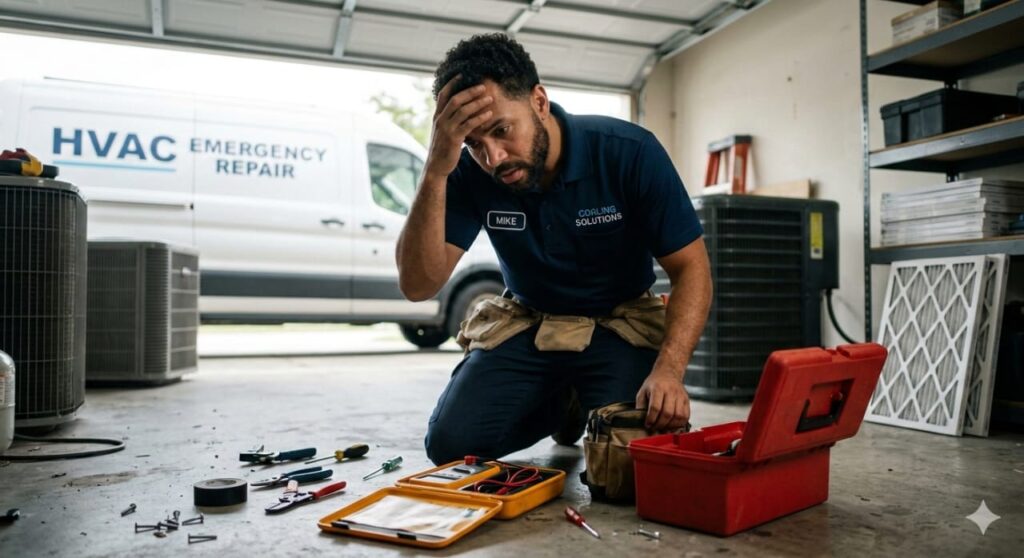
It’s 11:47 PM on a Thursday in July.
A homeowner in Phoenix wakes up in a sweat. Not the good kind. The kind that means their AC just died and the indoor thermometer reads 89 degrees.
They grab their phone and Google emergency HVAC repair near me. They find three companies. They call all three. Two go to voicemail. One rings out.
The next morning, one of those two companies yours, maybe wakes up to a missed call and a voicemail that ends with: …I actually ended up going with another company. Thanks anyway.
That lead is gone. That customer is gone. And there’s a very good chance they’re leaving a review that says “couldn’t reach anyone.”
This happens thousands of times every single day across the HVAC industry.
The Data Doesn’t Lie: After-Hours Is Peak Season for Leads
Here’s the uncomfortable truth for HVAC business owners: the hours your phones go quiet are often the hours your customers are most desperate.
Studies and industry surveys consistently show that roughly 40% of inbound HVAC service requests come in outside of standard business hours evenings, nights, weekends, and holidays. Think about what that means:
If your business generates 100 leads a week, approximately 40 of them are trying to reach you when no one is there to answer.
If you close even a third of the ones you do answer, you’re losing roughly 13 potential jobs every single week to silence.
Over a year, that’s hundreds of thousands of dollars in revenue that walked out the door because a phone rang in an empty office.
And it’s not just emergencies. Homeowners browse for HVAC services during their lunch break, after putting the kids to bed, or on a Sunday afternoon when they realize their system has been making that weird noise for two weeks. These are warm, motivated leads and if you’re not there to answer, your competitor is.
Why Voicemail Doesn’t Cut It Anymore
Before we talk about the solution, let’s be honest about why the old fallback leaving a voicemail no longer works the way it used to.
Consumer behavior has fundamentally shifted. People expect instant responses. Not because they’re impatient (well, sometimes), but because they’ve been trained by technology to expect it. Amazon delivers in a day. Uber shows up in four minutes. DoorDash tracks their food in real time.
When a homeowner with a broken furnace in January hears a voicemail greeting, here’s what happens psychologically:
They feel uncertain. “Will they even call back tonight?”
They feel unimportant. “This company doesn’t seem ready for me.”
They move on. The next Google result is right there.
Studies on lead response time show that the odds of qualifying a lead drop dramatically within the first five minutes of no contact. After an hour, you’re fighting an uphill battle. After overnight? Many of those leads have already booked someone else.
Voicemail isn’t a safety net. It’s a polite way of losing the lead more slowly.
What an AI Answering Service Actually Does
An AI answering service for HVAC businesses is not a robot reading from a script. Modern AI-powered phone and chat systems are trained to hold natural, contextually aware conversations and they do it around the clock, without sick days or overtime pay.
Here’s what actually happens when a lead comes in at midnight and your AI answering service picks up:
Step 1: Instant Engagement
The AI answers immediately on the first ring or the first chat message. The homeowner isn’t sent to voicemail. They’re greeted, by name if you have their info, and invited to describe their issue.
Step 2: Qualifying the Lead
The AI asks the right questions. Is this an emergency or a scheduled service? What type of system do they have? How old is the unit? What symptoms are they experiencing? These aren’t generic questions they’re tailored to HVAC, so the conversation feels relevant and professional.
Step 3: Booking or Escalating
Depending on the situation, the AI can:
- Schedule a service appointment directly into your dispatch calendar
- Collect contact information for a follow-up call first thing in the morning
- Escalate to an on-call technician for genuine emergencies
- Provide helpful guidance (like checking the thermostat or circuit breaker) while the appointment is being set
Step 4: Capturing Everything
Every call or chat is logged. Lead details, the nature of the issue, the time of contact, and what action was taken are all recorded and sent to you so your team wakes up to a full picture of what came in overnight, ready to act.
No lead falls through the cracks. No homeowner feels ignored. And your team shows up in the morning with a queue of booked appointments instead of a pile of unanswered voicemails.
The Real-World Impact: What HVAC Owners Are Seeing
Business owners who have implemented AI answering services report several consistent outcomes:
Higher lead capture rates. When every call gets answered, you stop hemorrhaging the 40% that used to go to voicemail. For many businesses, this alone represents a significant jump in monthly revenue.
Faster booking cycles. Because leads are qualified and booked in real time rather than waiting for a callback the next morning the time between first contact and booked appointment collapses dramatically.
Better customer experience. Homeowners, especially those dealing with emergencies, respond well to feeling heard and helped immediately. First impressions matter, and answering at midnight sends a powerful signal about how your business operates.
Less pressure on office staff. When the AI handles routine intake, scheduling, and FAQs, your office team is freed up to focus on customer relationships, follow-ups, and more complex situations that actually need human judgment.
Competitive differentiation. Most HVAC businesses still rely on voicemail after hours. Being the company that actually answers day or night is a genuine differentiator in markets where consumers have multiple options.
Common Objections (And Why They Don’t Hold Up)
My customers want to talk to a real person.
They want to feel heard and get results. An AI that answers within seconds, understands their issue, and books their appointment delivers a better experience than a voicemail followed by a 10-hour wait for a callback. If the interaction requires a human, the AI can escalate it to one.
What if the AI says something wrong?
Modern AI systems used in HVAC contexts are trained specifically for the industry and your business. They operate within defined guardrails. They don’t make promises about pricing or timelines they gather information and connect leads to your team. The risk of a misstep is far lower than the risk of losing 40% of your leads to silence.
“I don’t have a big enough operation to justify this.”
This is actually backwards. Small and mid-sized HVAC businesses benefit the most from AI answering services because they often can’t afford a full-time after-hours receptionist. The AI levels the playing field. A four-truck operation can now offer the same availability as a 20-truck company.
“It’s too expensive.”
When you calculate the cost per lead in your market and then calculate how many of those leads you’re currently losing after hours the math usually shifts quickly. Most businesses that implement AI answering services see positive ROI within the first 30 to 60 days.
What to Look for in an AI Answering Service for Your HVAC Business
Not all AI answering services are created equal. If you’re evaluating options, here are the factors that matter most for HVAC:
Industry-specific training. The AI should understand HVAC terminology, common issues, seasonal patterns, and the nature of emergency versus routine service calls. A generic call-answering bot won’t cut it.
Calendar integration. Real-time booking capability is non-negotiable. If the AI can’t actually put appointments on your dispatch calendar, you’re just getting lead collection not full automation.
Escalation protocols. For genuine emergencies a carbon monoxide concern, a burst pipe from a frozen coil the system should be able to reach an on-call technician immediately. Know how this works before you sign up.
CRM and reporting integration. Lead data should flow directly into whatever system you use to manage customers and jobs. Manual data entry defeats the purpose.
Customization. Your business has a specific service area, specific offerings, and a specific brand voice. The AI should reflect that not sound like every other HVAC company using the same platform.
Transparent reporting. You should be able to see how many calls came in, how many were handled, how many led to bookings, and what was said. Visibility matters.
The Opportunity Most HVAC Owners Are Still Sleeping On
Here’s the bigger picture.
HVAC is a relationship business. Homeowners who find a company they trust one that’s reliable, responsive, and easy to work with become repeat customers. They call you for maintenance. They call you when they need a replacement. They refer you to their neighbors.
But that relationship has to start somewhere. And increasingly, it starts with a phone call or a chat message at an inconvenient hour.
The companies that capture those moments are the ones building the customer bases that carry them through seasonal slow periods, economic uncertainty, and increasing competition. The companies that send those moments to voicemail are slowly giving away market share without realizing it.
AI answering services aren’t a luxury add-on for large HVAC enterprises. They’re becoming a baseline expectation the infrastructure for staying competitive in a market where consumers have options and attention spans measured in seconds.
Getting Started: What the First 30 Days Look Like
If you’ve never implemented an AI answering service before, the process is more straightforward than most business owners expect.
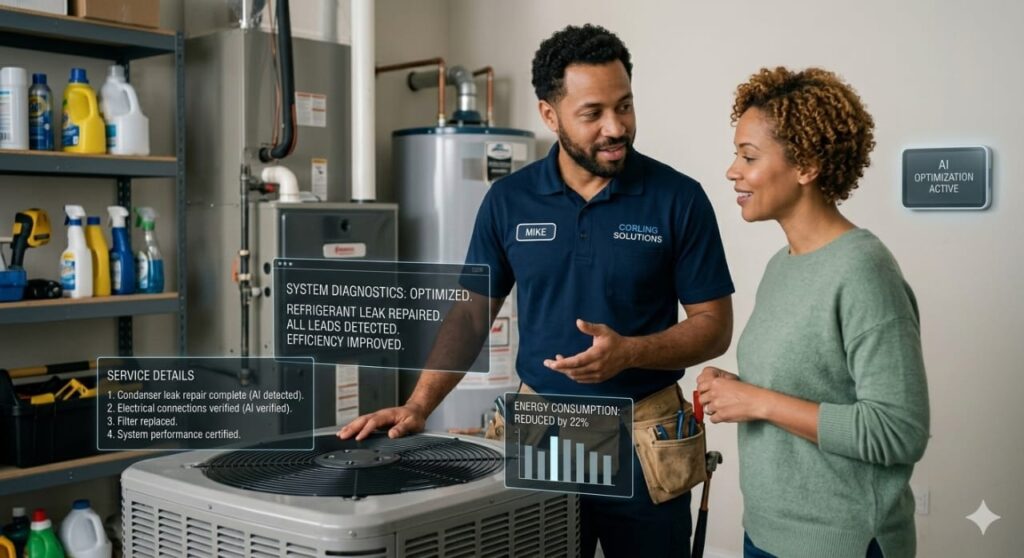
Week 1: Setup and customization. Your service area, job types, pricing logic, scheduling rules, and escalation protocols get configured. The AI is trained on your business specifics.
Week 2: Integration. The system connects to your existing calendar, CRM, or dispatch software. Call routing is established so inbound calls flow correctly.
Week 3: Testing and refinement. Real calls come in. You review how the AI handled them. Adjustments are made. Edge cases get addressed.
Week 4: Full deployment. The system runs independently. You and your team monitor performance through a dashboard and focus your energy on running the business not answering phones at 11 PM.
By the end of the first month, most businesses have already recovered leads they would have previously lost and have a clear picture of exactly how much value the system is generating.
Final Thought
Your HVAC business works hard to generate leads through Google ads, word of mouth, yard signs, Yelp reviews, and everything else. Every one of those leads cost you something, whether it was money, time, or reputation.
An AI answering service makes sure that investment doesn’t go to waste at the exact moment a potential customer is ready to book.
40% of your leads are coming in after hours. The question is: who’s answering?
Interested in implementing an AI answering service for your HVAC business? Contact Bot4orge AI to learn how we help home service companies capture every lead day or night.
