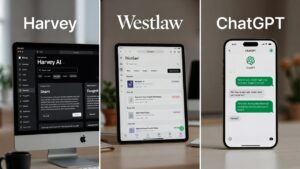
The question lands in legal circles constantly now, and it deserves a straight answer rather than a sales pitch in either direction. Can AI draft legal documents? The honest answer is: yes, partially, usefully, and with real limits that every attorney and law firm owner needs to understand before making any decisions.
This post does not exist to convince you that AI legal document drafting replaces lawyers. It does not. But it also does not exist to reassure you that AI is irrelevant to your practice, because that is equally untrue. The firms getting the most out of AI right now are the ones who drew a clear line between what the technology handles well and what it should never touch without a senior attorney in the loop.
That line is what this post is about.
Why This Question Matters Right Now
There was a version of this conversation five years ago that was mostly theoretical. The AI tools available then were clunky, inconsistent, and required enough technical setup that most small and mid-size law firms never got past the demo stage.
That is no longer the situation. The tools that exist today and the workflows being built on top of them are genuinely capable of producing usable first drafts, populating standard clause libraries, flagging missing provisions, and turning a document request into a structured starting point in minutes rather than hours.
So the question has stopped being “could AI eventually do this?” and become “what should AI be doing in my firm right now?” Those are very different questions, and the second one requires an honest look at capability rather than either hype or defensiveness.
What AI Drafting Genuinely Does Well
The capabilities here are real, and they are worth taking seriously. AI drafting tools have reached a point where they produce consistent, structured output on a class of documents that previously consumed significant attorney and paralegal time.
First drafts from intake data
When a client completes an intake form, an AI system can immediately generate a structured first draft populated with the client’s information names, dates, addresses, deal terms, party descriptions. What used to take a paralegal thirty to sixty minutes of copy-paste work happens in under two minutes, and the output is ready for attorney review rather than construction from scratch.
This is not a small efficiency gain. Across a firm handling volume real estate closings, employment contracts, standard business agreements the cumulative time reclaimed is substantial.
Standard and template-based documents
AI performs at its strongest when working within well-defined document categories. Non-disclosure agreements, standard employment contracts, simple service agreements, lease templates, and basic corporate formation documents are all within the reliable range of current AI drafting tools. The language is consistent, the structure follows established patterns, and the output requires review rather than reconstruction.
Clause libraries and variation generation
One of the more underrated applications is clause-level drafting. Rather than writing an entire contract, AI can generate five variations of an indemnification clause, a limitation of liability provision, or a dispute resolution section each tuned to a different risk posture giving the attorney options to select from and refine rather than drafting from a blank page.
Proofreading, inconsistency flagging, and formatting
AI is reliably useful for reviewing drafted documents for internal inconsistencies mismatched party names, contradictory clause references, missing standard provisions, and formatting irregularities. This kind of systematic review is exactly the work that human eyes miss after hours of document work, and AI catches it methodically every time.
Where Attorneys Still Lead Every Time
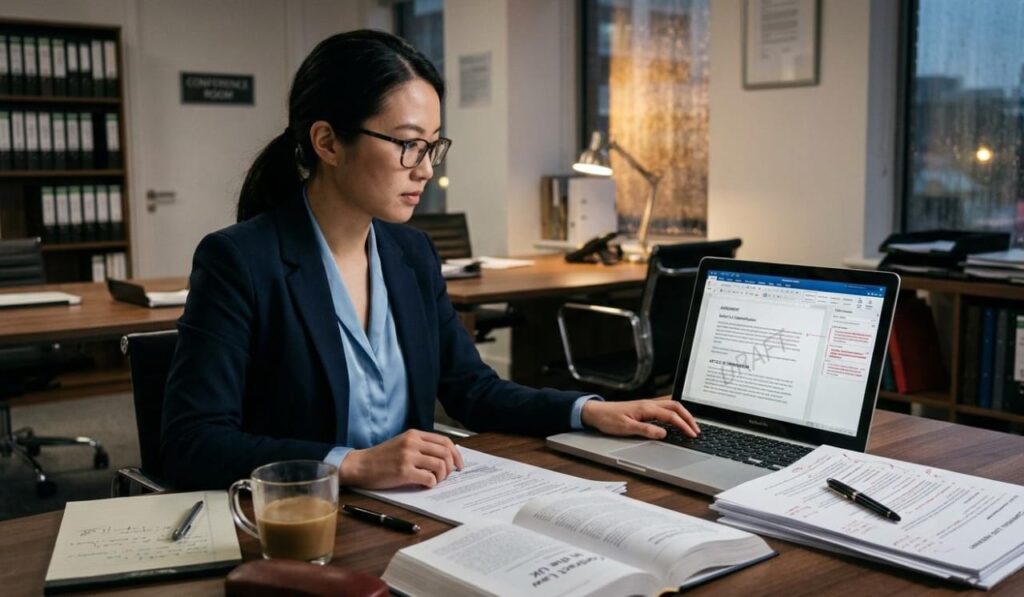
The capabilities above are real, but so are the limits. And the limits are not primarily about AI making grammatical errors or producing awkward phrasing. The limits are structural, and they matter enormously in a profession where the consequences of a poorly drafted document can be financial, reputational, or irreversible.
Judgment under uncertainty
AI drafts from patterns. It produces output that is statistically consistent with the documents it has been trained on, which means it performs well in predictable territory and poorly sometimes dangerously in novel situations. An attorney reading a contract brings judgment shaped by case outcomes, client relationships, negotiation history, and strategic context. That judgment is not pattern-matching. It is reasoning under uncertainty, and no current AI tool replicates it reliably.
Jurisdiction-specific nuance
Legal language that is standard and enforceable in one jurisdiction can be void, misleading, or actively harmful in another. AI tools trained on broad document corpora do not have reliable real-time awareness of how specific courts have interpreted specific clauses, what local statutory changes have recently altered enforceability, or how a particular judge tends to rule on certain provisions. Attorneys carry that knowledge. AI does not.
Client strategy and risk counselling
A contract is never just a document. It is a representation of a negotiated position, a risk allocation decision, and a statement of what the client is willing to live with if the relationship breaks down. Advising a client on those decisions what to push for, what to concede, what clause is worth fighting over and which is not is a strategic conversation that requires understanding the client’s actual business, risk tolerance, and long-term goals. AI cannot have that conversation.
Ethical responsibility
In every jurisdiction, the attorney signing off on a document carries professional responsibility for its content. That responsibility cannot be delegated to a software tool. When AI output goes out under an attorney’s name, the attorney has reviewed it, taken responsibility for it, and stands behind it. Firms that treat AI drafts as final output without that review step are not saving time. They are accumulating risk.
Document-by-Document Breakdown
Rather than speaking in abstractions, here is a practical breakdown of how AI performs across the document types that most law firms handle regularly.
The Right Mental Model for Law Firms
The firms that are implementing AI drafting most effectively are not thinking about it as a replacement for attorney work. They are thinking about it as a reallocation of attorney time. The goal is not fewer attorneys. The goal is attorneys spending their hours on the work that requires attorneys, rather than on the work that does not.
When a first draft that used to take forty-five minutes takes four, the attorney does not disappear from the process. The attorney reviews faster, catches issues sooner, has more time for the client relationship, and handles a higher volume of matters without burning out. The work that matters most gets more attention, not less.
What a supervised AI drafting workflow looks like
- A client completes an intake form
- AI generates a structured first draft within minutes
- The assigned attorney reviews and marks up the draft
- Any substantive changes are made by the attorney
- The final document goes out under the attorney’s review and signature
The AI does not send anything. It produces a starting point.
The competitive reality is that this is already happening. Law firms in every market segment are quietly implementing AI drafting tools and reclaiming hours that used to go to first-draft work. The firms that wait are not preserving quality they are ceding efficiency to competitors who have already figured out where the line is.
The line is not complicated. AI drafts. Attorneys judge. That division of labour is not a compromise. It is the entire point.