AI-powered email sequences solve the three structural problems that kill most email campaigns: wrong timing, no personalization, and a follow-up strategy that ends after a single send. If your email conversion rate is stuck, this is why — and here is exactly how to fix it.
Most businesses that struggle with email conversion spend their energy on the wrong problem. They rewrite subject lines, test different send days, tweak the button color on the CTA. Some of those things make a marginal difference. None of them address why the campaign is really underperforming.
The real reasons email campaigns fail to convert are structural. They are about what happens after the email goes out, not what the email says. They are about whether the right person received the right message at the right moment in their decision process. And they are about whether the campaign treated a non-response as the end of the conversation or the beginning of the next one.
Manual email campaigns have a fundamental ceiling on how well they can address any of these problems. AI-powered email sequences do not. The gap between the two is where most businesses are leaving conversions on the table.
The 3 Real Reasons Your Email Campaigns Are Not Converting
Before you can fix your email campaign conversion rate, you need to diagnose the actual problem. It is almost never the subject line.
1. Wrong Timing
A single send at a fixed time treats every subscriber the same. Some receive it mid-task and delete it. Some receive it on the day they were going to search for exactly what you offer. The campaign never knows the difference and never adjusts. Behavior-triggered emails eliminate this problem entirely.
2. No Personalization
The same email goes to a lead who just signed up, a lead who opened every email for six months without converting, and a past customer who bought once. Three completely different relationships, one identical message. None of them feel spoken to. AI-powered email sequences route each subscriber into the path that matches their actual behavior.
3. Zero Follow-Up
The email goes out. Some people open it. Most do not respond. The campaign ends. The lead who was genuinely interested but distracted when the email arrived never hears from you again. The sale was there. The follow-up strategy was not.
21%
Average open rate for manual batch email campaigns across service industries
47%
Higher open rates for behavior-triggered emails versus scheduled batch sends
80%
Of sales require at least five follow-up touches. Most email campaigns make one.
Eighty percent of sales require five or more follow-up touches. The average manual email campaign sends one. The gap between those two numbers is not a content problem or a design problem. It is a follow-up infrastructure problem — and it is the most fixable problem on this list.
How AI-Powered Email Sequences Fix the Timing Problem
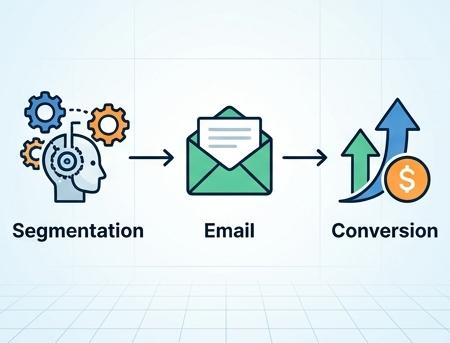
Send-time optimization is one of the most straightforward applications of AI in email marketing and one of the highest-impact ones. Rather than sending every email at a fixed time chosen by the marketer, AI analyzes the historical open and click behavior of each individual subscriber and delivers the email at the time that person is statistically most likely to engage with it.
The difference in open rate between sending at an optimal individual time versus a fixed batch time is consistently significant — often ten to twenty percentage points. On a list of two thousand subscribers, that is two hundred to four hundred additional opens from the same email with no changes to the content.
Beyond send-time optimization, AI-powered email sequences also handle behavioral triggering: sending emails based on what the subscriber has just done rather than where they sit on a calendar. A subscriber who just visited the pricing page receives a relevant email within the hour. A subscriber who clicked a link in the previous email but did not convert receives a follow-up that acknowledges that specific action. The timing is set by what the subscriber is actually doing, not by what month the campaign is scheduled for.
How AI-Powered Email Sequences Fix the Personalization Problem
True email personalization is not inserting a first name into a subject line. It is delivering content that reflects where the subscriber is in their relationship with the business, what they have engaged with, what they have not responded to, and what stage of the decision process they appear to be in.
AI-powered segmentation makes this possible at scale by continuously updating each subscriber’s profile based on their behavior and routing them into the sequence that matches their current state.
- New subscriber, no engagement: Receives an onboarding sequence designed to establish trust and introduce the business’s core value before making any ask
- Opened multiple emails, never clicked: Receives a sequence with a lower-friction CTA — a question, a short survey, or a direct offer rather than another informational message
- Clicked but did not convert: Receives a follow-up that references the specific content they engaged with and addresses the most common objection for that offer
- Past customer, inactive 90 days: Receives a re-engagement sequence with a different message than a cold prospect who has never bought
- Forwarded an email or shared a link: Automatically flagged as a high-engagement contact and moved into a higher-intent nurture track
Each of these subscribers is on a different path through the same email program. The content they receive reflects their specific situation rather than treating the entire list as a single homogeneous audience. That relevance is what converts.
How AI-Powered Email Sequences Fix the Follow-Up Problem
The follow-up problem is the most commercially significant of the three because it is where the most recoverable revenue sits. Every email campaign that sends once and stops is leaving a percentage of interested subscribers who simply were not ready to act on that day, who were distracted when the email arrived, or who needed one more piece of information before they could move forward.
An AI-powered email sequence continues the conversation with those subscribers automatically, across multiple touches, at the right intervals, with content that is calibrated to the specific reason they have not yet converted.
AI-Powered Email Sequence vs. Manual Campaign: A Step-by-Step Breakdown
Day 1 — Initial Send (Both Approaches)
Initial email goes out. Offer, announcement, or campaign message delivered to the relevant segment. Both manual and AI campaigns start here.
48 Hours, No Open — AI Only: Automatic Resend
For subscribers who did not open: resend with a different subject line automatically. Not a duplicate — a repositioned version of the same message. Manual campaigns rarely do this. When they do, it is done manually for the whole list, not per subscriber.
Opened, No Click — AI Only: Behavior Branch
Subscriber opened but did not click. AI routes them into a nurture branch: a follow-up that adds more context, addresses a likely objection, or offers a lower-commitment next step. Manual campaigns treat openers and non-clickers identically.
Clicked, No Convert — AI Only: High-Intent Follow-Up
Subscriber clicked but did not convert. This is the highest-intent signal in the sequence. AI triggers a direct, personalized follow-up within hours referencing what they clicked and removing the most likely friction point. Most manual campaigns let this moment pass entirely.
Days 5–7 — AI Only: Value-Add Re-Engagement
For non-converters still in the sequence: a value-add email that deepens the case without repeating the original ask. A case study, a result, a piece of content that moves the subscriber closer to the decision without feeling like another sales push.
Days 10–14 — AI Only: Final Touch
For subscribers who have received the full sequence without converting: a closing message that creates a natural endpoint. A direct question, a limited-time element, or a simple ask that gives the subscriber a clear reason to either act or confirm they are not interested so the list stays clean.
A manual campaign sends an email. An AI-powered email sequence has a conversation. The difference in conversion rate reflects exactly that.
Manual Campaign vs. AI-Powered Email Sequence: Side-by-Side Comparison
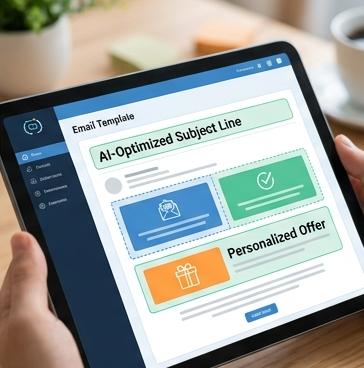
| Element | Manual Campaign | AI-Powered Email Sequence |
|---|---|---|
| Send timing | Fixed schedule chosen by the marketer, same for everyone | Optimized per subscriber based on individual open history |
| Segmentation | Broad list segments updated manually and infrequently | Continuous real-time segmentation based on live behavior |
| Non-openers | Receive nothing further or the next scheduled email | Automatically receive a repositioned resend within 48 hours |
| High-intent signals | Click without conversion goes unrecognized and unfollowed | Triggers an immediate personalized follow-up within hours |
| Follow-up touches | One to two sends per campaign, then the list goes cold | Five to ten behavior-driven touches across 14–30 days |
| Personalization depth | First name and basic segment. Same message to everyone. | Content reflects the subscriber’s stage, behavior, and history |
| List hygiene | Manual unsubscribe management. Inactive contacts accumulate. | Automated sunset sequences remove unengaged contacts cleanly |
Real Results: What AI-Powered Email Sequences Actually Produce
A service business sends a campaign to a list of 1,500 subscribers. Their manual campaign produces a 20% open rate and a 2% click-to-conversion rate, generating 6 conversions. After switching to an AI-powered email sequence with behavioral triggers, send-time optimization, and a five-touch follow-up structure, their open rate rises to 31% and click-to-conversion rises to 4.8%. The same list now generates 22 conversions from the same campaign.
At a $500 average transaction value, that is $8,000 in additional revenue from the same email list — no increase in ad spend, no list growth, no change to the offer. The sequence changed. Everything else stayed the same.
The Subject Line Is Not the Problem
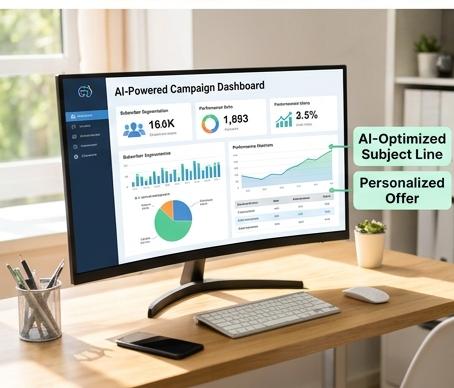
Most businesses that are not happy with their email marketing performance focus their energy on the message itself: the copy, the design, the subject line, the CTA button. These things matter at the margin. A genuinely bad subject line will suppress open rates. But a great subject line cannot compensate for an email that arrives at the wrong moment, speaks to the wrong stage of the subscriber’s journey, and is never followed up on.
The businesses that consistently convert from email are not the ones with the cleverest subject lines. They are the ones using AI-powered email sequences that treat every subscriber as an individual — sending at the moment that individual is most likely to engage, and continuing the conversation intelligently until the subscriber either converts or makes clear they are not going to.
AI makes that possible for businesses that do not have a full-time email strategist and a team of copywriters. It handles the behavioral logic, the timing optimization, the sequence branching, and the follow-up automatically. The business focuses on what it wants to say. The system handles when, to whom, and what comes next.
Frequently Asked Questions About AI-Powered Email Sequences
What is an AI-powered email sequence?
An AI-powered email sequence is an automated series of emails triggered and personalized by subscriber behavior — such as opens, clicks, page visits, and purchase history — rather than sent on a fixed calendar schedule. Unlike manual campaigns, AI sequences branch and adapt based on what each subscriber does, delivering the right message at the right moment automatically.
How much better are AI email sequences compared to manual campaigns?
Behavior-triggered emails generate up to 47% higher open rates than scheduled batch sends. Businesses using AI-powered sequences with five or more follow-up touches typically see conversion rates two to three times higher than single-send manual campaigns.
What problems do AI-powered email sequences solve?
AI-powered email sequences address the three core failure points in manual campaigns: sending at the wrong time, delivering the same message to every subscriber regardless of where they are in the buying process, and failing to follow up after the initial send.
How many follow-up emails does an AI sequence send?
A well-structured AI email sequence typically sends five to ten touches over a 14-to-30-day window, adjusting content and timing based on what each subscriber does. This aligns with research showing 80% of sales require at least five follow-up contacts.
Do I need a large email list for AI sequences to work?
No. AI-powered email sequences are effective even with a small list because they maximize the conversion potential of every subscriber rather than relying on volume to generate results. A list of 500 well-nurtured subscribers will consistently outperform a list of 5,000 receiving generic batch emails.
Build AI-Powered Email Sequences That Actually Convert
See how Bot4orge builds AI-powered email automation for service businesses and what behavior-triggered sequences could mean for your conversion rate this quarter.
Book a Free Demo — See Your AI Email Seqhttps://bot4orge.com/contact/uence