If you’re still calling customers to confirm appointments, following up on estimates by phone, and chasing people down after a job — you’re spending time you don’t have on a problem that’s already been solved.
The HVAC companies pulling ahead in 2026 aren’t just faster at doing the work. They’re faster at everything around the work — booking, confirming, following up, and collecting reviews. And the tool making that possible isn’t some expensive enterprise software. It’s SMS, powered by AI.
This post breaks down exactly how it works, why it performs better than phone calls and emails for most customer interactions, and how to set it up without a tech background.
Why SMS Works Better Than Phone and Email for HVAC Customer Communication
Let’s start with the numbers, because they’re hard to argue with.
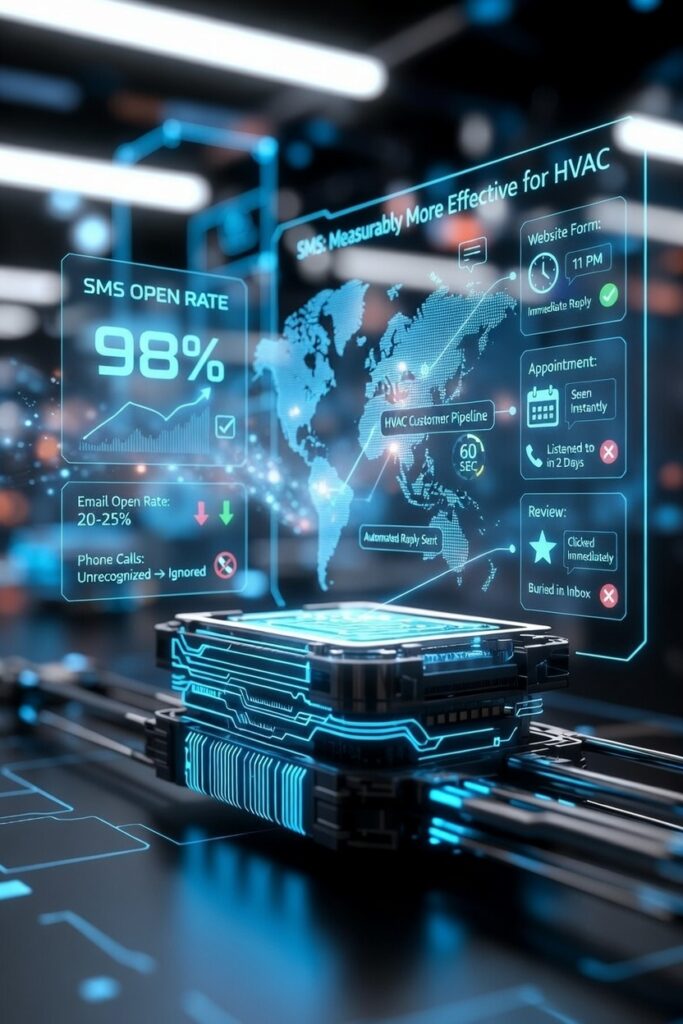
The average SMS open rate is around 98%. The average email open rate in the home services industry is closer to 20–25%. Phone calls? A growing percentage of customers — especially under 45 — won’t answer numbers they don’t recognize at all.
For HVAC companies, this matters at every stage of the customer relationship:
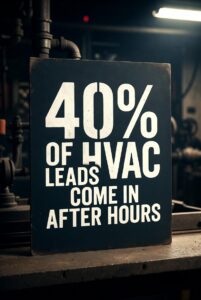
- A customer fills out your website form at 11 PM. If you call back the next morning, there’s a good chance they’ve already booked someone else. A text back within 60 seconds — even automated — keeps them in your pipeline.
- An appointment confirmation sent by text gets seen. A voicemail might not get listened to for two days.
- A review request sent by SMS right after a job gets clicked. The same request sent by email gets buried.
SMS isn’t just a convenience. For the kinds of time-sensitive interactions HVAC businesses have with customers every day, it’s measurably more effective.
Where AI Comes In
Sending texts manually isn’t the answer — that’s just trading one time drain for another. The reason this works at scale is because AI handles the sending, the timing, the personalization, and the follow-up automatically.
Here’s what an AI + SMS system actually does in an HVAC context:
1. Instant Lead Response
When someone fills out a contact form, calls after hours, or messages your chatbot, an AI-powered SMS system responds within seconds — not hours. The message uses their name, references what they asked about, and gives them a clear next step (book a time, call us, get a quote).
Speed-to-lead is one of the biggest conversion factors in home services. Studies consistently show that responding within 5 minutes of a lead coming in dramatically increases the chance of booking. Most small HVAC companies can’t staff for that. AI can.
2. Appointment Confirmations and Reminders
No-shows and last-minute cancellations cost HVAC companies real money — a missed appointment slot on a booked-out day can mean losing $300 to $800 in revenue with no way to backfill it.
AI-powered SMS reminders send automatically at the right intervals — 48 hours out, 24 hours out, and the morning of the appointment. Customers can confirm, reschedule, or cancel directly by replying to the text. The system updates your calendar in real time and, if someone cancels, can automatically notify the next customer on the waitlist.
3. “Tech on the Way” Notifications
Customers hate waiting without information. An AI SMS system can automatically send a message when a tech is dispatched — including the tech’s name, an estimated arrival window, and even a photo or bio in some platforms. This single touchpoint dramatically reduces “where is my tech?” calls to your office, which frees up whoever is answering your phones.
4. Post-Job Follow-Up and Review Requests
The window for getting a Google review is short. A customer is most likely to leave one within 1–2 hours of a positive service experience. After that, the moment passes and life gets in the way.
An AI SMS system sends a follow-up automatically when the tech marks the job complete. It thanks the customer by name, asks how everything went, and includes a direct link to your Google Business review page. If they respond negatively, the system routes the feedback to you privately instead of pushing them to a public review.
5. Maintenance Contract Reminders and Upsells
This is where the compounding value shows up. A customer who had their AC serviced 11 months ago is a warm lead for a tune-up. An AI system can automatically send a personalized text at the right time — referencing their equipment, the last service date, and a simple booking link. No one on your team has to remember. No spreadsheet needs to be managed.
What This Looks Like in Practice
Here’s a realistic example of an AI + SMS workflow for a 4-truck HVAC company running a busy summer season:
Monday morning, a homeowner submits a form requesting AC repair. Within 45 seconds, they get a text: “Hi Sarah, this is Mike’s HVAC — we got your request and we’d love to help. We have openings tomorrow between 10 AM and 2 PM. Reply YES to book or call us at [number].” Sarah replies YES. She’s booked.
Tuesday at 8 AM, Sarah gets a reminder text: “Just a reminder — your appointment with Mike’s HVAC is today between 10 AM and 2 PM. Reply C to confirm or R to reschedule.” She replies C.
At 10:15 AM, when the tech is dispatched, Sarah gets: “Your tech, James, is on his way and should arrive by 10:45 AM. He’ll have everything needed to diagnose your AC.”
At 1:30 PM, after James marks the job complete in the app, Sarah gets: “Hi Sarah — thanks for choosing Mike’s HVAC today. We hope James took good care of you! If you have a minute, we’d really appreciate a quick Google review: [link].” She taps the link and leaves a 5-star review.
Eleven months later, Sarah gets: “Hi Sarah, it’s been almost a year since we serviced your AC unit. Summer’s coming — want to book a tune-up before the heat hits? We’re booking fast: [link].” She books again.
Every single one of those touchpoints happened automatically. Nobody on the Mike’s HVAC team did anything after the initial setup.
The Tools That Make This Happen
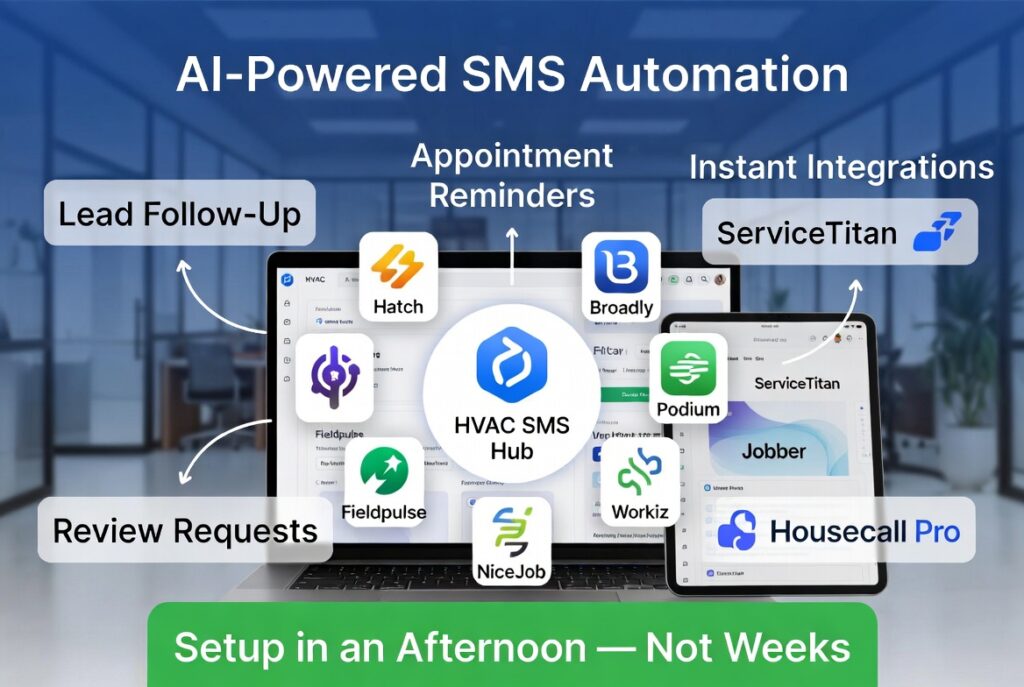
You don’t need to build this from scratch. Several platforms are designed specifically for home service businesses and have HVAC-ready SMS automation built in:
- Hatch — Built specifically for home services, with AI-powered lead follow-up and multi-channel messaging including SMS, email, and voicemail drops.
- Broadly — Strong on review automation and post-job follow-up SMS, integrates with most HVAC service platforms.
- Podium — Well-known in the trades for SMS-first customer communication, with AI response features and payment collection via text.
- Fieldpulse / Workiz — Field service management platforms with built-in SMS automation for appointment reminders and job notifications.
- NiceJob — Focused on review generation via SMS, with smart timing built around job completion data.
Most of these integrate directly with ServiceTitan, Jobber, or Housecall Pro if you’re already running one of those platforms. Setup typically takes an afternoon, not a week.
What About Customers Who Don’t Want Texts?
This comes up often, and it’s worth addressing directly. Every compliant SMS system requires opt-in from customers — either through a booking form checkbox, a verbal confirmation captured by your team, or by initiating the text conversation themselves (like replying to a web form).
In practice, opt-out rates for service-based SMS are very low — usually under 2–3% — because the messages are genuinely useful. Customers want to know their tech is on the way. They want a simple way to confirm or reschedule. They don’t want to be on hold. SMS gives them what they actually need without friction.
The key is keeping messages functional, not promotional. Confirmations, reminders, and follow-ups are welcome. Blasting your whole customer list with a discount offer every month is how you get opt-outs and spam complaints.
The Compliance Side
A quick note on regulations: business SMS communication in the US is governed by the Telephone Consumer Protection Act (TCPA) and, since late 2023, FCC rules have been tightened around consent requirements. This sounds more complicated than it is.
If you’re using a reputable platform like the ones listed above, compliance is handled for you — opt-in language, opt-out management, and proper message identification are built into the system. You’re not navigating this alone. But it is worth asking any vendor you evaluate: “How do you handle TCPA compliance?” before you sign up.
Is This Worth It for a Small HVAC Operation?
If you’re running 1–3 trucks and doing everything yourself, you might wonder whether this is overkill. It’s not — it might actually matter more at smaller scale, because every lead you lose to a slow response and every no-show you absorb hits your revenue harder.
For a solo operator or small team, even one saved job per month from faster lead response, plus one no-show prevented by SMS reminders, plus five Google reviews generated automatically — that alone justifies the $100–$300/month most of these tools cost.
For a 5–10 truck operation, the math becomes even clearer. The volume of customer interactions is high enough that manual follow-up is genuinely impossible to do well. AI + SMS is how you maintain a high-touch customer experience without adding headcount.
The Bottom Line
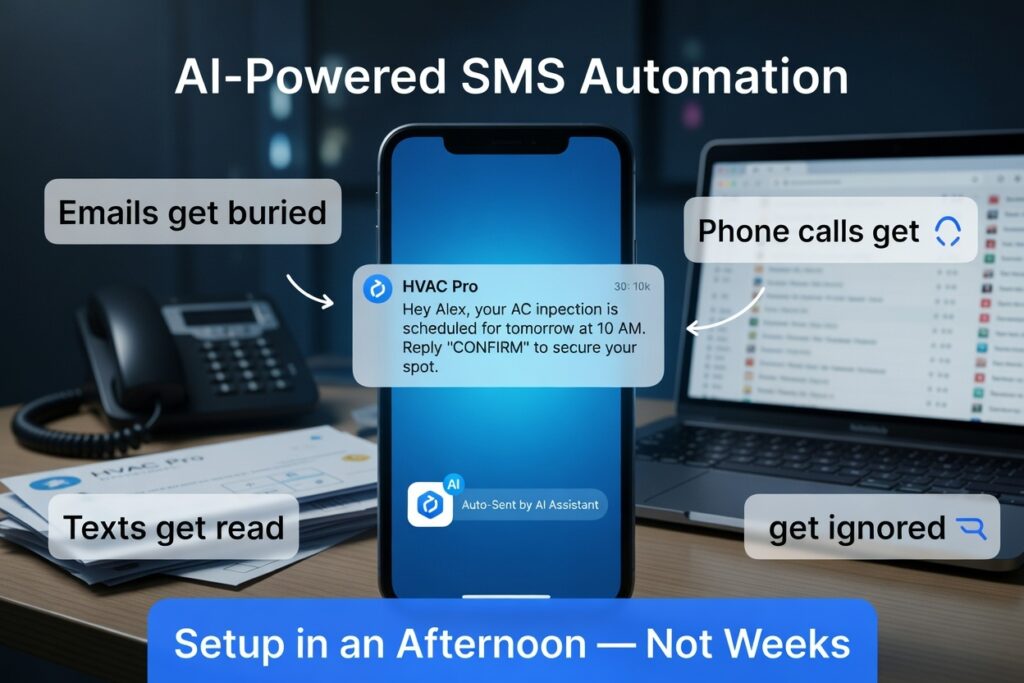
Phone calls get ignored. Emails get buried. Texts get read.
That’s not a trend — that’s where customer communication has settled, and the HVAC companies winning local market share in 2026 are the ones who have built their customer communication around that reality.
AI + SMS isn’t about replacing the personal touch that makes a great service business. It’s about making sure the right message reaches the right customer at the right time — every time — without your team having to remember to send it.
Set it up once. Let it run. And stop losing jobs to competitors who picked up faster.
Want to go deeper?
Check out our related guides:
- How an AI Answering Service Helped This HVAC Company Stop Losing $10K a Month in Missed Calls
- Set It and Forget It: How HVAC Companies Are Automating Customer Follow-Ups and Getting More 5-Star Reviews
- HVAC No-Shows Are Killing Your Schedule. Here’s How AI Appointment Reminders Fix It