A practical guide for HVAC and home service companies ready to automate operations and scale without adding headcount.
THE REAL COST OF THE CHAOS
It’s a Monday morning. Three jobs are on the board. Two techs called out. A customer is ringing the office line. And you’re still trying to figure out who’s going where.
If this sounds familiar, you’re not alone. Scheduling and dispatching is one of the most time-consuming and error-prone tasks in any HVAC or home service business. And most owners either burn themselves out doing it or hire a full-time office manager just to keep up.
But here’s the thing: you don’t have to choose between chaos and headcount.
AI can now handle a significant chunk of your scheduling and dispatch workflow automatically, consistently, and at a fraction of the cost.
This post will show you exactly how AI handles the scheduling and dispatch load so you can stop being the bottleneck in your own business.
WHY SCHEDULING AND DISPATCH BREAK DOWN
Before we get into the fix, let’s name the problem clearly.
Most small HVAC companies run their scheduling through a combination of:
- A whiteboard or spreadsheet
- A shared Google Calendar (that’s always out of date)
- Text messages back and forth with techs
- Phone calls to confirm appointments
- Someone’s memory filling in the gaps
This works barely until it doesn’t. And when it breaks, it costs you:
- Missed appointments that kill your reviews
- Double-booked techs that waste their time and yours
- Jobs that fall through the cracks entirely
- Customers who call to cancel before your tech even shows up
- Hours every week of your time or your office manager’s time doing reactive damage control
The root issue isn’t a people problem. It’s a systems problem. And AI solves systems problems.
WHAT AI ACTUALLY DOES IN SCHEDULING AND DISPATCH
When people hear AI for scheduling, they imagine robots replacing humans. That’s not what this is.
Think of AI as a highly capable coordinator working in the background 24/7 one that never forgets, never gets overwhelmed, and never needs a lunch break.
Here’s what it actually handles:
1. Intelligent Job Booking
AI can take incoming service requests from your website, a form, a missed-call text, or even a voice message and turn them into structured job entries automatically.
It captures the customer name, address, issue type, and preferred time window. No data entry required from you.
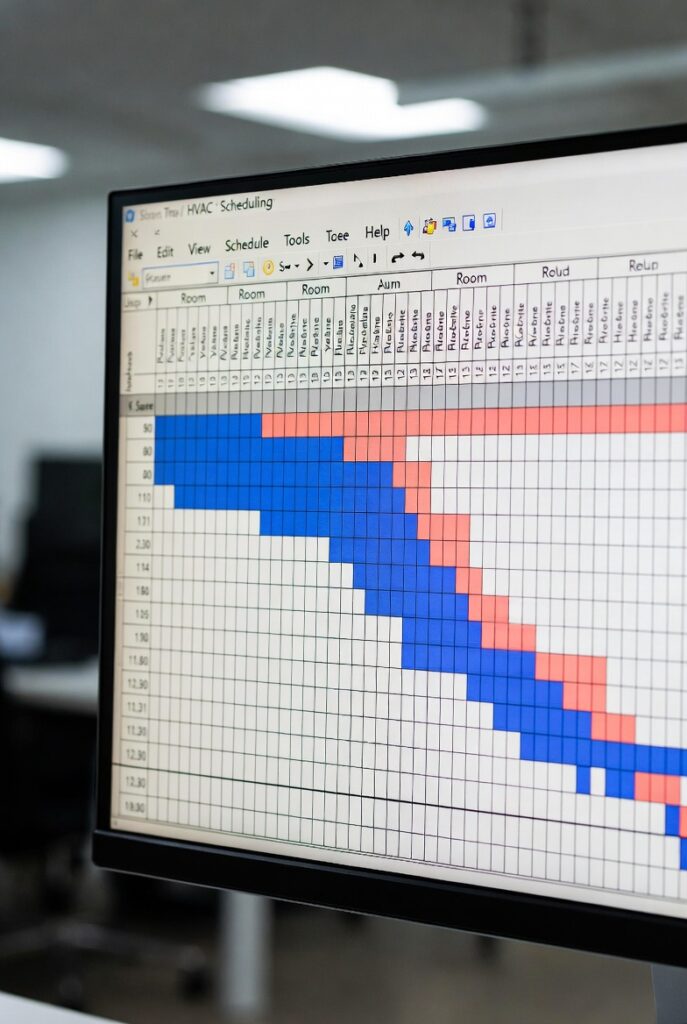
2. Smart Scheduling Based on Logic
Once a job is logged, AI can match it to the right tech based on:
- Proximity: Who’s already in that area?
- Skill set: Which tech is certified to handle that type of job?
- Availability: Who has an open slot that fits the customer’s window?
- Workload: Who’s already carrying a full day vs. who has capacity?
Instead of you manually playing Tetris with your schedule, the AI fills it in based on rules you set once.
3. Automated Tech Notifications
Once a job is assigned, the tech gets an automatic notification with:
- Job address and customer contact info
- Job type and any relevant notes
- Arrival time window
- Any special instructions
No more calling each tech individually. No more I didn’t see the message as an excuse.
4. Customer Confirmation and Reminders
AI sends automatic texts or emails to customers confirming their appointment and reminding them 24 hours and 2 hours before the tech arrives.
This alone can cut no-shows by 30–50% which means fewer wasted hours for your techs and better revenue per day.
5. Real-Time Rescheduling
Tech called out sick? Job ran long? Customer needs to reschedule last minute?
AI can automatically detect the conflict and suggest alternatives reassigning the slot to another available tech or sending the customer options to pick a new time, all without you lifting a finger.
THE REAL-WORLD MATH: WHAT THIS SAVES YOU
Let’s run the numbers for a small HVAC company running 5–10 jobs per day.
Conservative estimate: AI scheduling automation saves 2–4 hours per day in admin time. At even $20/hour, that’s $800–$1,600/month in recovered time before you factor in the cost of a full-time hire.
An office manager in the US costs $35,000–$55,000/year in salary alone. AI scheduling tools typically run $200–$600/month. The math is hard to ignore.
HOW IT WORKS IN PRACTICE: A TYPICAL DAY
Here’s what a day looks like for a small HVAC company that has implemented AI scheduling:
6:00 AM Overnight service requests are automatically sorted and added to the next-day job queue. No one had to touch them.
7:00 AM The system has already assigned jobs to each tech based on location, skill, and capacity. Each tech wakes up to their schedule in their phone.
8:30 AM A customer texts to reschedule. The AI handles the conversation, finds an open slot, reassigns the original tech to a different job, and confirms with both parties.
11:00 AM A job runs long. The AI flags the delay, automatically pushes back the next appointment by 30 minutes, and notifies the customer.
5:00 PM End-of-day summary is auto-generated: jobs completed, revenue collected, any open items for tomorrow.
The owner? They spent their day doing actual owner work not playing scheduler.
WHAT YOU NEED TO GET STARTED
You don’t need to overhaul your entire operation overnight. Here’s a practical starting path:
Step 1: Audit Your Current Workflow
Write down every step involved in scheduling a job from the moment a customer contacts you to the moment a tech is dispatched. Identify where the most time and errors occur.
Step 2: Define Your Dispatching Rules
AI needs to know your logic. Common rules include:
- Which techs handle which job types
- What geographic zones each tech covers
- How long each job type typically takes
- What your standard scheduling windows are
Step 3: Choose the Right Tool
There are several AI-powered field service platforms built specifically for HVAC and trades businesses. Look for:
- CRM integration: Can it sync with what you already use?
- Automated notifications: Does it text/email customers and techs automatically?
- Mobile-friendly: Can your techs access their schedule from their phone?
- Rescheduling logic: Does it handle real-time changes automatically?
Step 4: Set Up and Test
Run the AI system in parallel with your current process for 1–2 weeks before fully switching. This lets you catch edge cases and adjust your rules before going live.
Step 5: Hand It Off
Once the system is running smoothly, document the process and step back. Your AI handles the daily scheduling grind. You focus on growth.

COMMON QUESTIONS FROM HVAC OWNERS
What if a job has unusual circumstances?
AI handles standard scheduling. For edge cases complex jobs, premium clients, emergency situations you or a team member can override any decision. Think of AI as a very capable default, not a rigid rulebook.
My techs aren’t tech-savvy. Will they use it?
The best platforms are designed for tradespeople, not software engineers. Techs receive a simple text or app notification with everything they need. Most adapt within a week.
What about customers who prefer to call?
AI can handle inbound phone calls too using voice AI to capture job details, confirm availability, and book appointments. Customers get answered immediately instead of going to voicemail.
Is my data secure?
Reputable platforms use encrypted, cloud-based storage with standard security protocols. Your customer data is no more at risk than it is in a shared Google Sheet and typically far more secure.
THE BOTTOM LINE
Scheduling and dispatch doesn’t have to be your bottleneck. It doesn’t have to drain your time, create constant errors, or force you to hire someone just to manage the chaos.
AI can now handle the coordination work intelligently, automatically, and around the clock while you focus on running your business.
Small HVAC companies that adopt AI scheduling aren’t just saving time. They’re building the infrastructure to scale without adding overhead. That means more jobs, better reviews, and fewer fires to put out every morning.
You built this business with your hands and your expertise. Let AI handle the paperwork. That’s what it’s there for.
READY TO TAKE THE FIRST STEP?
Bot4orge builds custom AI scheduling and automation systems for HVAC companies.
Book a free strategy call and see what’s possible for your operation.