You didn’t lose that customer to a better HVAC company, instead you lost them to a company that simply answered the phone.
A homeowner’s AC dies at 8 PM in July. they call the first HVAC company on Google, no answer. They call the second, no answer. By the time they reach the third, there’s a response, and that is the company that gets the job and the $3,000 invoice that comes with it.
Was that company better than yours? Almost certainly not. They were just available.
The difference between those two businesses is not skill, reputation, or pricing. It is one system running quietly in the background: an AI voice agent that answers calls, qualifies leads, and schedules jobs around the clock.
A lot of HVAC business owners know missed calls hurt. Few have actually counted what those calls are worth. This post does that math for you and shows you exactly how to fix it.
What Is an AI Answering System and How Does It Actually Work?
An AI answering system is not a voicemail. It is not a call centre. It is not a scripted bot that frustrates callers with robotic menus.
A modern AI answering system uses natural language processing, the same foundational technology behind tools like ChatGPT, to hold a real, dynamic conversation with your caller in real time. It listens, understands context, asks intelligent follow up questions, and responds in a way that feels natural rather than automated.
The platforms currently powering these systems for trade service businesses include Bland AI, Vapi, and Retell AI. Each can be configured specifically around the language, workflow, and service structure of an HVAC operation.
Here is exactly what a well configured AI answering system does inside an HVAC business:
Instant Call Answering
Every inbound call is answered immediately regardless of the time. No hold music. No voicemail. No missed opportunity.
Intelligent Lead Qualification
The system identifies the nature of the call and asks the right contextual questions. What system is it? How old is the unit? What are the symptoms? This is information your technician actually needs, gathered automatically before you enter the conversation.
Direct Calendar Scheduling
Appointments are scheduled directly into your existing calendar or dispatch system using integrations with tools like Google Calendar, Calendly, or your field service management software.
Automatic Lead Capture
Full caller details including name, address, contact number, and issue summary are logged automatically without a single manual entry from your team.
Emergency Routing
If a caller describes an urgent situation such as a gas leak, a furnace failure in freezing temperatures, or a flooded basement, the system flags it immediately for human follow up rather than treating it like a routine booking.
Round the Clock Operation
All of the above happens at 2 AM on a Sunday without overtime, without errors, and without a single moment of hold time.
What Missed Calls Are Actually Costing You
The numbers most HVAC owners have never sat down to calculate are the ones that hurt the most.
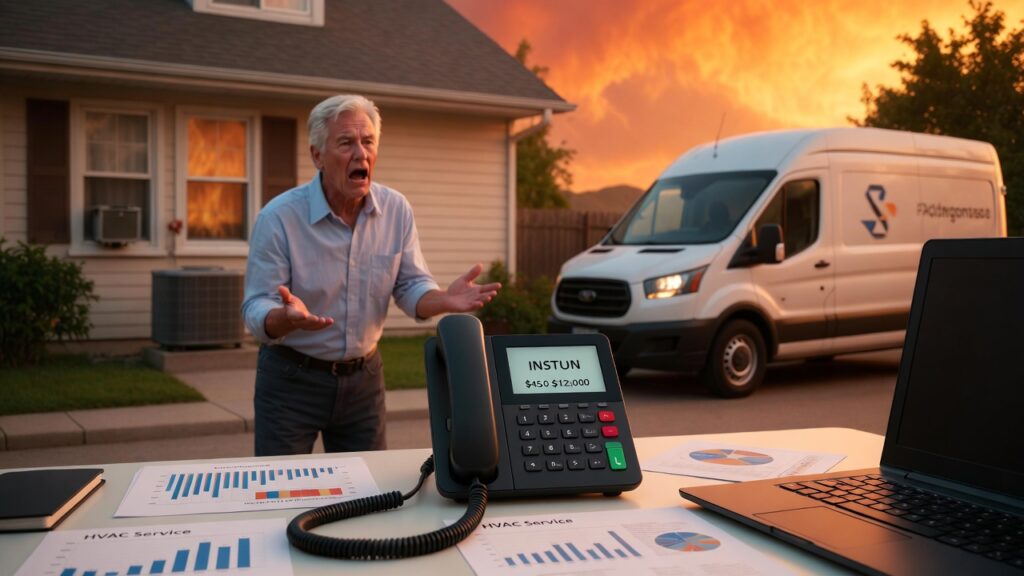
The average HVAC service call is worth between $250 and $500 at the door. But that is only the beginning. When you factor in repeat business from a satisfied customer, referrals, annual maintenance contracts averaging $150 to $300 per year, and equipment replacement jobs running between $3,000 and $12,000, the lifetime value of a single HVAC customer sits between $2,000 and $8,000.
Every missed call is not just a missed job. It is a missed relationship worth thousands of dollars over time.
Studies on small service businesses show that between 30% and 62% of inbound calls go unanswered especially during peak hours, overlapping jobs, and after 5 PM. For a mid-sized HVAC company handling 15 to 25 calls per day, that is 5 to 15 unanswered calls every single day.
Being conservative, say you miss just 3 calls a day. Over a month that is 90 missed calls. If only 30% of those were ready to book, that is 27 lost jobs. At an average of $350 per job, that is $9,450 in direct revenue lost in a single month. Multiply by 12 and you are looking at over $113,000 a year from unanswered calls alone.
And none of that accounts for lifetime customer value.
After Hours Is Where the Real Damage Happens
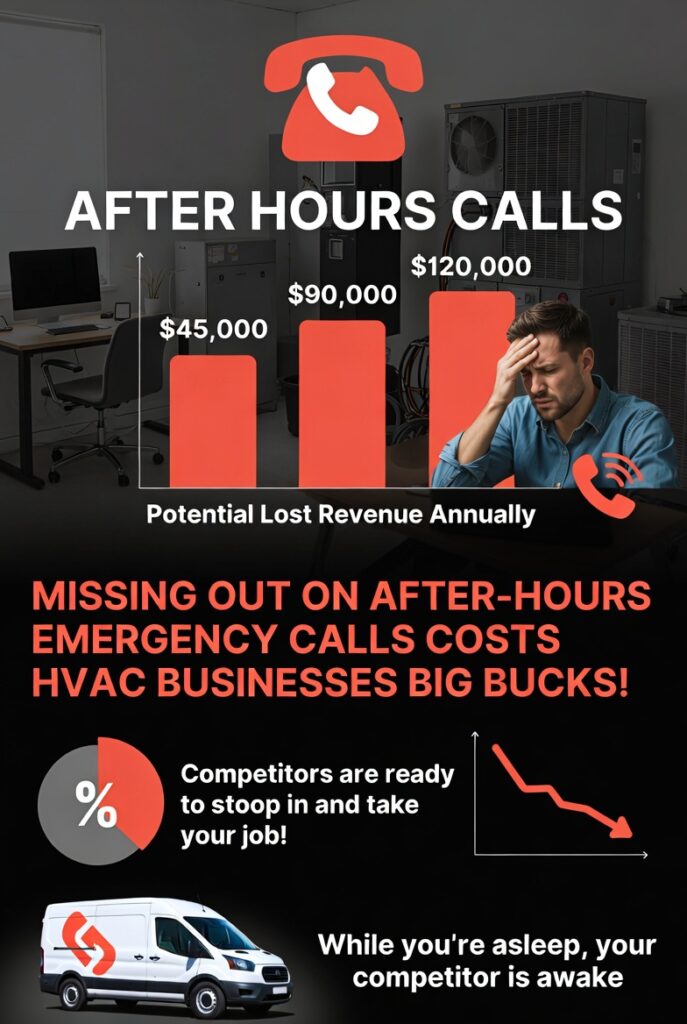
Here is what makes after hours calls uniquely valuable: urgency.
A homeowner calling at 9 PM is not browsing options. They have a broken furnace in January. A flooded basement. An AC unit that failed during a heatwave with a newborn in the house. They need someone now and they will pay a premium for it.
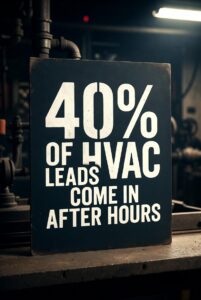
Emergency HVAC calls typically command 1.5x to 2x standard rates. The conversion rate on after hours calls that get answered is significantly higher than daytime calls because the caller is already committed before the conversation even begins.
When your business goes dark after 5 PM you are not losing average jobs. You are losing your best jobs. The high urgency, high margin calls that your competitors are capturing while you sleep.
Why a Receptionist or Answering Service Does Not Solve This
There are three options most HVAC owners consider when they finally decide to address missed calls. Here is an honest breakdown of each.
Option 1: Hire a Full Time Receptionist
Cost: $35,000 to $50,000 per year including salary, benefits, and training. Still cannot cover every hour of every day. Still gets sick. Still needs holidays.
Option 2: Use a Traditional Answering Service
Cheaper upfront but comes with significant limitations. Long hold times, scripted responses, and agents who have no knowledge of HVAC and cannot qualify a lead, answer a technical question, or make a judgment call about urgency. The caller experience suffers and conversions drop.
Option 3: Deploy an AI Answering System
A fraction of the cost of a single receptionist salary. Available every hour of every day. Handles multiple calls simultaneously during peak periods. Qualifies leads, schedules appointments, captures data, and routes emergencies, all automatically and all correctly.
The setup cost pays for itself within the first few captured after hours calls. After that it is pure margin recovery.
This Is Not Just an HVAC Problem
The same missed call crisis playing out in HVAC businesses every night is happening across the legal industry as well.
A potential client calling a law firm at 7 PM after an accident does not want voicemail. They want to know if they have a case. They want to feel like someone is in their corner right now. Every unanswered call is a potential client who found another firm simply because that firm picked up the phone.
An AI intake system built for a legal practice qualifies the caller, captures their case details, explains next steps, and schedules a consultation, all before a single attorney is involved. The underlying technology is identical to what powers HVAC answering systems. The configuration is industry specific. The result is the same. A business that never sleeps and never loses a high value opportunity to a competitor simply because nobody picked up.
How to Calculate Your Own After Hours Opportunity
Run this four step framework against your own call data:
Step 1: Count Your After Hours Calls
Estimate how many calls you receive between 5 PM and 8 AM on weekdays plus weekends. Check your call logs or ask your team for a rough count.
Step 2: Apply the Booking Rate
Multiply that number by 0.4. This is a conservative estimate of how many of those callers would have booked if someone had answered.
Step 3: Multiply by Your Average Job Value
Take that number and multiply it by what your average job is worth at the door.
Step 4: Annualise the Figure
Multiply by 12.
Whatever that number is, that is what your business is leaving on the table every year by going dark after hours.
Common Mistakes to Avoid When Implementing AI Answering Systems
Setting it up without configuring it for your industry.
A generic AI answering system will frustrate HVAC callers. The system needs to be trained on your services, your terminology, your pricing structure, and your emergency protocols before it goes live.
Treating it as a replacement for all human interaction.
AI handles the volume. Humans handle the relationship. The goal is not to remove your team from the process. It is to make sure no opportunity falls through the cracks before your team gets involved.
Not tracking the results.
Measure calls answered, leads captured, appointments booked, and revenue attributed to after hours calls from day one. Without data you cannot prove ROI and you cannot improve the system over time.
Waiting until peak season to implement.
The businesses that have AI answering systems running before summer and winter peaks are the ones capturing the highest margin emergency calls. Implementation takes time. Start before you need it.
The Bottom Line
Missed calls are not a minor inconvenience. They are a structural revenue leak that compounds quietly over time as lost customers choose competitors and never return.
AI answering systems are not a future investment. They are an available, proven, and affordable solution running inside businesses like yours right now, capturing revenue, protecting reputation, and working through the night without a single hour of overtime.
The next call that comes in after hours should not go to your competitor.
If you want to see exactly what an AI answering system would look like inside your HVAC or legal practice operation, book a free 15 minute walkthrough with our team at bot4orge.com.